When I started researching waterproof ratings for Bluetooth speakers, I quickly realized how confusing the terminology can be. You’ve probably seen labels like “IPX7 waterproof” or “water-resistant” on speaker packaging, but what do these ratings actually mean? After diving deep into the International Electrotechnical Commission’s IEC 60529 standard and consulting with accredited testing laboratories, I’ve compiled this comprehensive guide to help you understand exactly what protection level you’re getting.
The waterproof rating system for Bluetooth speakers follows a globally recognized standard called IEC 60529, which defines Ingress Protection (IP) ratings. These ratings tell you precisely how well a device is protected against solid particles and liquids. For Bluetooth speakers, we typically see IPX ratings, where the “X” replaces the dust protection digit, focusing solely on water resistance.
Understanding these ratings is crucial when investing in a Bluetooth speaker. The difference between IPX4 and IPX7 could mean the difference between a speaker that survives a poolside splash and one that can handle complete submersion. I’ll break down each rating level, explain the testing procedures behind them, and help you determine which protection level suits your needs.
The IEC 60529 Standard: Foundation of IP Ratings
The IEC 60529 standard, established by the International Electrotechnical Commission, provides the global framework for classifying degrees of protection provided by enclosures. This standard isn’t just for Bluetooth speakers – it applies to all electrical equipment enclosures. The IEC Technical Committee 70 maintains and updates this standard, ensuring it remains relevant as technology evolves.
According to the IEC’s official documentation, the IP Code consists of two digits following the letters “IP.” The first digit (0-6) indicates protection against solid particles like dust, while the second digit (0-9K) indicates protection against water ingress. When manufacturers use “IPX” ratings for Bluetooth speakers, they’re indicating that dust protection hasn’t been formally tested, focusing instead on water resistance.
Accredited testing laboratories like F2 Labs and Keystone Compliance, both ISO-17025 certified facilities, conduct rigorous testing according to IEC 60529 specifications. These labs use precisely calibrated equipment to ensure products meet the exact requirements for each protection level. The testing procedures are standardized globally, meaning an IPX7 rating in the United States means the same thing as an IPX7 rating in Europe or Asia.
The European Committee for Electrotechnical Standardization (CENELEC) publishes EN 60529, which is the European Union’s adoption of the IEC standard. This harmonization ensures that waterproof ratings remain consistent across international markets, giving consumers confidence regardless of where they purchase their devices.
Complete IPX Rating Scale Breakdown
Let me walk you through each IPX rating level, from IPX0 to IPX9K, explaining exactly what protection each offers for your Bluetooth speaker.
IPX0: No Protection
IPX0 means the device has no special protection against water. These speakers should be kept completely away from moisture. While rare in modern Bluetooth speakers, some budget indoor models might carry this rating. If you see IPX0 or no rating at all, assume the speaker cannot handle any water exposure.
IPX1: Protection Against Dripping Water
IPX1-rated devices can withstand vertically falling water drops for 10 minutes. The test involves dripping water at a rate of 1mm per minute. This minimal protection might handle light condensation but won’t protect against any real water exposure. I rarely see IPX1 ratings on Bluetooth speakers anymore, as manufacturers recognize consumers expect better protection.
IPX2: Protection Against Tilted Dripping Water
IPX2 offers protection when the enclosure is tilted up to 15 degrees from vertical. The test lasts 10 minutes with 3mm of water per minute. This rating provides slightly better protection than IPX1 but still isn’t suitable for outdoor use or bathroom environments where speakers might encounter splashes.
IPX3: Protection Against Spraying Water
IPX3-rated speakers can handle water sprayed at angles up to 60 degrees from vertical. Testing involves spraying water at 0.7 liters per minute for at least 5 minutes. This level starts to offer meaningful protection for indoor use in humid environments, but it’s still not suitable for direct splashes or outdoor use.
IPX4: Protection Against Splashing Water
IPX4 is where we start seeing practical water resistance for Bluetooth speakers. These devices can withstand water splashing from any direction. The test involves spraying 10 liters per minute for at least 5 minutes from all angles. IPX4 speakers can handle kitchen countertops, light rain, and accidental spills, making them suitable for casual outdoor use.
During IPX4 testing at accredited labs like Keystone Compliance, speakers are mounted on a turntable and subjected to water spray from oscillating tubes. The water pressure and flow rate are precisely controlled to ensure consistent testing across all products. This level of protection makes IPX4 speakers popular for workout sessions, as they can handle sweat and light moisture.
IPX5: Protection Against Water Jets
IPX5-rated speakers can withstand water jets from a 6.3mm nozzle projecting 12.5 liters per minute from any direction. The test duration is at least 3 minutes, with water projected from 3 meters away. This rating provides solid protection for outdoor activities, including use near pools, beaches, or during moderate rain.
I’ve observed that IPX5 represents a significant jump in protection from IPX4. These speakers can handle direct shower spray, making them perfect for bathroom use. They can also withstand being rinsed clean after getting sandy or dirty, though you shouldn’t submerge them.
IPX6: Protection Against Powerful Water Jets
IPX6 certification requires surviving powerful water jets from a 12.5mm nozzle at 100 liters per minute for at least 3 minutes. This aggressive testing simulates conditions like heavy seas or powerful shower jets. IPX6 speakers can handle almost any above-water scenario, including use on boats, heavy rainstorms, or poolside environments with significant splashing.
TÜV SÜD and other international testing bodies use specialized equipment to achieve the precise pressure and flow rates required for IPX6 testing. The water jet must maintain consistent pressure throughout the test, and the speaker must continue functioning normally afterward.
IPX7: Protection Against Temporary Immersion
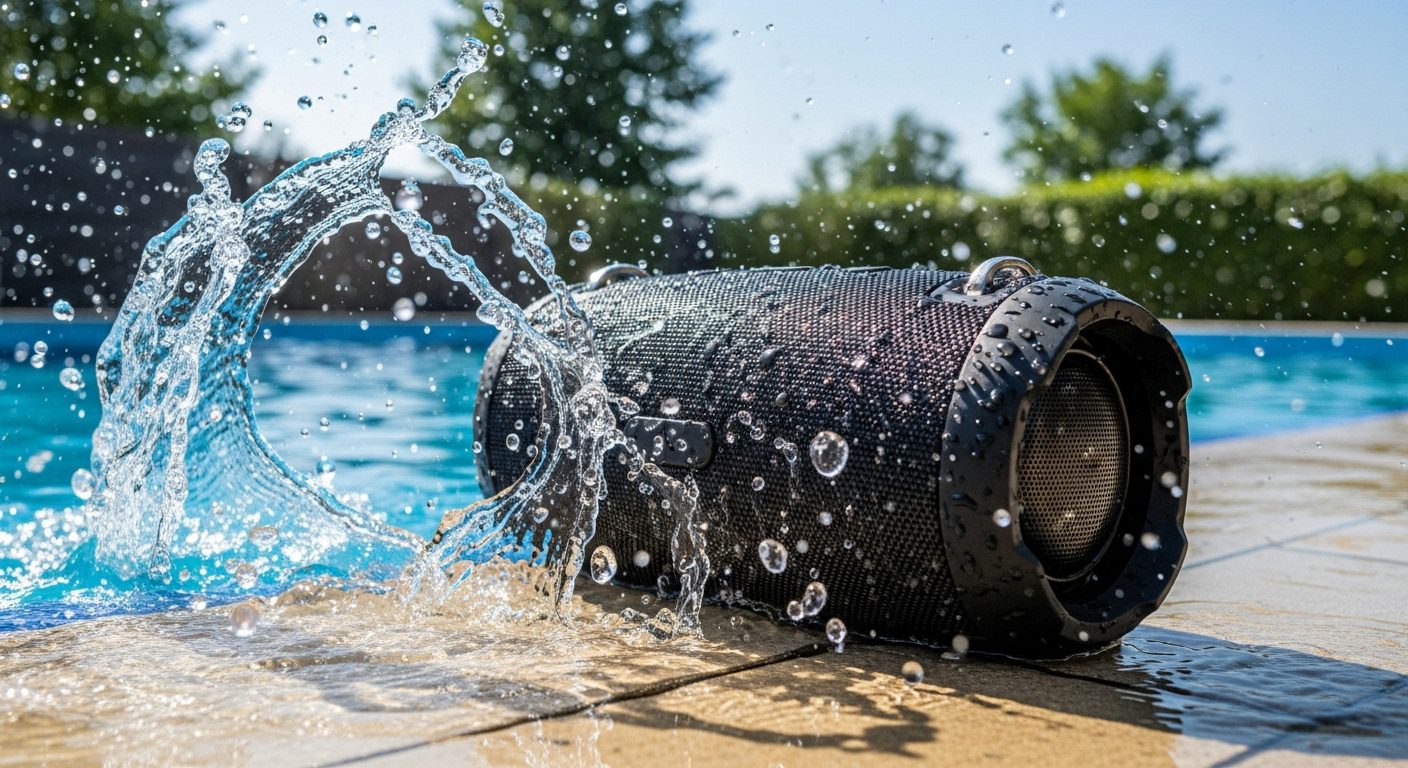
IPX7 is perhaps the most common rating for premium Bluetooth speakers, and for good reason. These devices can survive immersion in water up to 1 meter deep for 30 minutes. This doesn’t mean they’re designed for underwater use – the rating assumes accidental immersion, like dropping the speaker in a pool or bathtub.
The IPX7 testing protocol requires complete submersion with the lowest point of the enclosure at least 1 meter below the water surface. The speaker must remain functional after removal and drying. Interestingly, IPX7 doesn’t automatically include protection against water jets (IPX5/6), which is why some manufacturers test for multiple ratings.
Most IPX7 speakers can handle beach trips, pool parties, and accidental drops in water. However, the 30-minute time limit is important – extended submersion beyond this period isn’t covered by the rating. Also, the 1-meter depth limit means deeper submersion could cause failure due to increased water pressure.
IPX8: Protection Against Continuous Immersion
IPX8 represents the highest standard water protection level for consumer electronics. The exact test conditions are agreed upon between the manufacturer and testing facility but must exceed IPX7 requirements. Typically, IPX8 speakers can handle submersion beyond 1 meter for extended periods.
Each manufacturer defines their IPX8 specifications differently. Some guarantee protection at 2 meters for 60 minutes, while others might specify 3 meters for 30 minutes. Always check the manufacturer’s specific claims for IPX8-rated products. These speakers are ideal for water sports enthusiasts, swimmers, and anyone who needs guaranteed protection in wet environments.
IPX9K: Protection Against High-Pressure, High-Temperature Water Jets
IPX9K is a specialized rating rarely seen in consumer Bluetooth speakers. It certifies protection against high-pressure (80-100 bar), high-temperature (80°C) water jets from multiple angles. This industrial-grade protection is typically reserved for automotive applications and heavy machinery rather than consumer audio equipment.
Waterproof vs. Water-Resistant: Understanding the Technical Difference
One of the most common sources of confusion I encounter is the distinction between “waterproof” and “water-resistant.” Technically speaking, no consumer electronic device is truly “waterproof” – they’re all water-resistant to varying degrees. The IEC 60529 standard doesn’t use the term “waterproof” at all; it only defines degrees of protection against water ingress.
Water-resistant typically refers to IPX1 through IPX6 ratings, where devices can handle water exposure but not submersion. These speakers have seals and gaskets that prevent water from entering through normal exposure like rain or splashes. The protection is designed for incidental contact with water, not deliberate submersion.
Products marketed as “waterproof” usually carry IPX7 or IPX8 ratings, meaning they can survive temporary or continuous immersion. However, even these “waterproof” speakers have limitations. Water pressure increases with depth, and extended submersion can eventually compromise seals. Additionally, waterproof ratings typically apply to fresh water – salt water, chlorinated pool water, and other liquids can damage seals over time.
The distinction becomes particularly important for warranty claims. If your IPX4 “water-resistant” speaker fails after being submerged, the manufacturer likely won’t honor the warranty. Understanding these technical differences helps set realistic expectations and prevents costly mistakes.
Real-World Applications and Scenarios
Let me translate these technical ratings into practical scenarios to help you choose the right protection level for your needs.
Home and Indoor Use
For indoor use in dry environments, any IPX rating works fine. However, if you’re placing a speaker in a bathroom, kitchen, or home gym, I recommend at least IPX4. These areas experience humidity, steam, and occasional splashes that could damage unprotected electronics. IPX4 provides peace of mind for everyday indoor moisture exposure.
Poolside and Beach Use
Pool parties and beach trips demand higher protection levels. I strongly recommend IPX7 as the minimum for these environments. Speakers near pools inevitably get splashed, and beach environments add sand and salt water to the equation. IPX7 ensures your speaker survives accidental drops in the pool or getting hit by waves at the beach.
Remember that sand can be as problematic as water. While IPX ratings don’t address particle protection (that’s the first digit in full IP ratings), speakers with higher water protection typically have better overall sealing that helps keep sand out too.
Shower and Bathroom Use
For shower speakers, IPX5 is the practical minimum, though IPX7 provides better long-term reliability. Shower environments combine direct water spray with high humidity and temperature fluctuations. The constant exposure to moisture can challenge lower-rated speakers over time. IPX7 speakers can handle being directly in the shower stream without worry.
Outdoor Adventures and Camping
Hiking, camping, and outdoor adventures require versatile protection. IPX6 or IPX7 ratings work best for these activities. You might encounter rain, river crossings, or accidental drops in streams. IPX7 provides the best all-around protection for unpredictable outdoor conditions. Some adventurers prefer IPX6 if they’re more concerned about powerful rain than submersion.
Marine and Watersports
Boats, kayaks, and other marine environments demand the highest protection levels. IPX7 should be considered the absolute minimum, with IPX8 being ideal. Salt water adds corrosion concerns beyond just water ingress. Look for speakers specifically marketed for marine use, as they often include additional corrosion-resistant materials and coatings.
For activities like paddleboarding or kayaking where the speaker might repeatedly get submerged, IPX8 provides the best protection. The extended submersion capability gives you confidence even if the speaker spends significant time underwater.
Testing Methodology and Certification Process
Understanding how manufacturers test and certify IPX ratings helps you evaluate product claims. Legitimate ratings require testing at accredited laboratories following strict IEC 60529 protocols.
The testing process begins with conditioning the product at room temperature and standard atmospheric pressure. For water resistance tests, the water temperature must be within 5°C of the product temperature to avoid thermal shock effects. Accredited labs like F2 Labs use deionized water to ensure consistent results.
During testing, products must maintain their claimed functionality. For Bluetooth speakers, this means they must continue playing audio, maintain wireless connectivity, and respond to controls. Some tests allow for minor water ingress as long as it doesn’t affect functionality or safety.
After water exposure, products undergo functional testing to verify they still meet specifications. Many labs also perform teardown inspections to check for internal water ingress. Any water that enters must not compromise safety or long-term reliability.
Certification requires passing tests on multiple samples to ensure consistency. Reputable manufacturers test production samples regularly, not just prototypes. Look for products tested by recognized laboratories like Intertek, TÜV SÜD, F2 Labs, or Keystone Compliance. These facilities maintain ISO-17025 accreditation, ensuring their test results are globally recognized.
Common Misconceptions and Marketing Claims
Through my research, I’ve identified several misconceptions about waterproof ratings that can lead to damaged speakers and frustrated consumers.
Misconception: Higher Numbers Always Mean Better Protection
This isn’t necessarily true. IPX7 provides immersion protection that IPX5 doesn’t, but IPX5 protects against water jets while IPX7 technically doesn’t unless separately tested. Some manufacturers test for multiple ratings, like “IPX5/IPX7,” indicating protection against both jets and immersion.
Misconception: Waterproof Means Indestructible
IPX ratings only address water ingress. They don’t guarantee protection against impact, extreme temperatures, or chemical exposure. Dropping a waterproof speaker can damage seals, compromising water resistance. Similarly, exposure to salt water, chlorine, or soap can degrade seals over time.
Misconception: Testing Conditions Match Real-World Use
Laboratory testing uses controlled conditions with clean, room-temperature water. Real-world conditions involve temperature variations, water pressure changes, and potentially corrosive substances. Hot tub water, for instance, combines high temperature with chemicals that can challenge seals beyond standard testing parameters.
Warning: Fake or Misleading Ratings
Unfortunately, some manufacturers make unsubstantiated waterproof claims. Red flags include vague terminology like “splash-proof” without IPX ratings, claims without citing testing laboratories, or suspiciously cheap products with high ratings. Legitimate manufacturers proudly display their IPX ratings and can provide certification details upon request.
Always check if the manufacturer specifies which laboratory performed the testing. Reputable companies use accredited third-party labs rather than self-certification. If you can’t find certification information, be skeptical of waterproof claims.
Maintenance and Longevity of Waterproof Speakers
Even the best waterproof ratings don’t guarantee indefinite protection. Seals degrade over time, and proper maintenance extends your speaker’s water resistance longevity.
After salt water or chlorinated water exposure, rinse your speaker with fresh water. Salt crystals and chemical residues can degrade rubber seals and corrode charging ports. Let the speaker dry completely before charging, even if it has waterproof charging ports.
Regularly check rubber seals and gaskets for damage. Many waterproof speakers have rubber flaps covering charging ports – these are critical for maintaining water resistance. Replace damaged seals promptly, as even small tears can compromise protection.
Avoid extreme temperature changes when your speaker is wet. Moving a cold, wet speaker into a hot environment can create pressure differentials that force water past seals. Similarly, frozen water can expand and damage seals.
Store your speaker in a cool, dry place when not in use. Prolonged exposure to direct sunlight can degrade rubber seals, while constant humidity can promote corrosion even in waterproof designs.
Industry Standards and Future Developments
The IEC continues refining the 60529 standard as technology evolves. Recent discussions include adding specific test protocols for wearable devices and updating immersion tests to better reflect real-world usage patterns.
Manufacturers are developing new sealing technologies that maintain water resistance while improving sound quality. Traditional waterproof designs can muffle audio by restricting speaker cone movement. New materials and designs, including nano-coatings and hydrophobic meshes, promise better acoustic performance without sacrificing protection.
We’re also seeing convergence between dust and water protection. More manufacturers are pursuing full IP67 or IP68 ratings rather than just IPX ratings. This trend reflects consumer demand for truly ruggedized products that can handle any environment.
The industry is also addressing sustainability concerns. Some manufacturers now use recyclable sealing materials and design products for easier repair, extending product lifespan while maintaining protection standards.
Choosing the Right IPX Rating for Your Needs
Selecting the appropriate waterproof rating depends on your intended use, budget, and risk tolerance. Here’s my practical guide for different users:
Casual Indoor Users
If you primarily use your speaker indoors with occasional outdoor use, IPX4 provides adequate protection. This rating handles humidity, light rain, and accidental spills while keeping costs reasonable. You’ll find plenty of quality IPX4 speakers at various price points.
Active Lifestyle Users
For gym sessions, running, cycling, and outdoor workouts, I recommend IPX5 minimum, with IPX7 being ideal. The higher rating provides peace of mind during intense workouts and unexpected weather. The price difference between IPX5 and IPX7 speakers has narrowed considerably, making IPX7 increasingly attractive.
Water Enthusiasts
If water is central to your activities – swimming, surfing, sailing, or just lounging by the pool – IPX7 is the minimum acceptable rating. IPX8 provides extra insurance for serious water exposure. Consider speakers specifically designed for marine use, as they often include additional corrosion protection.
Adventure Seekers
For camping, hiking, and unpredictable outdoor adventures, IPX7 offers the best balance of protection and practicality. These speakers can handle rain, river crossings, and accidental submersion while remaining reasonably portable and affordable.
Professional Users
If you need a speaker for work environments with water exposure – construction sites, kitchens, workshops – prioritize durability alongside water resistance. Look for IPX6 or IPX7 ratings combined with impact-resistant construction. Some professional-grade speakers also include dust protection (IP67 instead of IPX7).
Frequently Asked Questions
What does IPX7 mean for a Bluetooth speaker?
IPX7 means the Bluetooth speaker can be submerged in water up to 1 meter deep for up to 30 minutes without damage. The “IP” stands for Ingress Protection, “X” means dust protection wasn’t tested, and “7” indicates the water protection level. This rating makes the speaker suitable for pool parties, beach use, and accidental drops in water.
What’s the difference between IPX4 and IPX7?
IPX4 protects against splashing water from any direction but cannot be submerged. IPX7 can be completely submerged up to 1 meter for 30 minutes. IPX4 is fine for light rain and splashes, while IPX7 handles full immersion, making it better for pools, beaches, and marine environments.
Can I swim with an IPX8 speaker?
While IPX8 speakers can handle continuous immersion, they’re not necessarily designed for swimming activities. Water pressure changes from movement, depth variations, and impact from waves can exceed testing parameters. Check the manufacturer’s specific recommendations, as some IPX8 speakers are explicitly designed for swimming while others aren’t.
Do waterproof ratings expire?
The rating itself doesn’t expire, but the speaker’s ability to maintain that protection level degrades over time. Rubber seals age, gaskets wear out, and repeated compression can compromise waterproofing. Most manufacturers consider waterproofing as wearing components not covered by extended warranties.
Is IPX6 better than IPX7?
Neither is definitively better – they protect against different threats. IPX6 protects against powerful water jets but not submersion. IPX7 protects against submersion but technically not powerful jets. For most users, IPX7 is more practical since accidental submersion is more common than exposure to high-pressure water jets.
Can I shower with an IPX4 speaker?
While IPX4 can handle splashes, direct shower spray might exceed its protection level. IPX4 protects against splashing from any angle but not sustained water jets. For regular shower use, I recommend at least IPX5, which is tested against water jets, or ideally IPX7 for long-term reliability.
What about salt water and chlorinated pools?
IPX ratings only guarantee protection against fresh water. Salt water and pool chemicals can corrode seals and components faster than fresh water. Always rinse salt or chlorinated water off your speaker with fresh water and dry it thoroughly. Some manufacturers specifically test for salt water resistance, which they’ll advertise separately.
How do I know if a waterproof rating is legitimate?
Look for specific IPX ratings rather than vague terms like “water-resistant.” Reputable manufacturers list their testing laboratory and can provide certification details. Check if the company mentions IEC 60529 standard compliance. Be skeptical of extremely cheap products claiming high waterproof ratings.
Can dropping my waterproof speaker damage its water resistance?
Yes, impacts can damage seals and gaskets that provide water protection. Even if the speaker continues working after a drop, its waterproof rating might be compromised. Inspect rubber seals and port covers for damage after any significant impact.
Why don’t all speakers just use IPX8?
Higher waterproof ratings increase manufacturing costs through additional sealing, testing, and quality control. They can also affect acoustic performance, as extensive sealing can restrict speaker cone movement. Many users don’t need IPX8 protection, so manufacturers balance protection, performance, and price for different market segments.
Conclusion
Understanding Bluetooth speaker waterproof ratings empowers you to make informed purchasing decisions and properly care for your devices. The IEC 60529 standard provides a reliable framework for evaluating water protection, but remember that these ratings represent minimum performance under specific test conditions.
For most users, IPX4 offers adequate protection for careful outdoor use, IPX5 or IPX6 handles more demanding environments, and IPX7 provides excellent all-around water protection. IPX8 serves specialized needs where extended submersion is likely. Consider your typical usage scenarios, but also think about unexpected situations where extra protection provides valuable insurance.
Remember that waterproof ratings are just one aspect of speaker durability. Build quality, seal maintenance, and proper care ultimately determine how long your speaker maintains its water resistance. Regular maintenance, especially after exposure to salt water or chemicals, significantly extends protection longevity.
As technology advances, we’re seeing better integration of waterproofing with acoustic performance and overall durability. The current generation of waterproof Bluetooth speakers offers impressive protection without significant compromises in sound quality or portability. By understanding what these ratings truly mean and choosing appropriately for your needs, you can enjoy your music wherever life takes you, regardless of the weather or environment.

![Best SD Cards [cy]: Top-Rated Memory Cards Tested](https://www.guidespot.com/wp-content/uploads/2026/07/featured-1783552957341-370x245.jpg "15 Best SD Cards (2026): Top-Rated Memory Cards Tested")